Discovering an active aerial envelope or an active subterranean burrow disrupts household safety, particularly when stinging insects colonize high-traffic areas near patios, entryways, or play structures. Stinging…
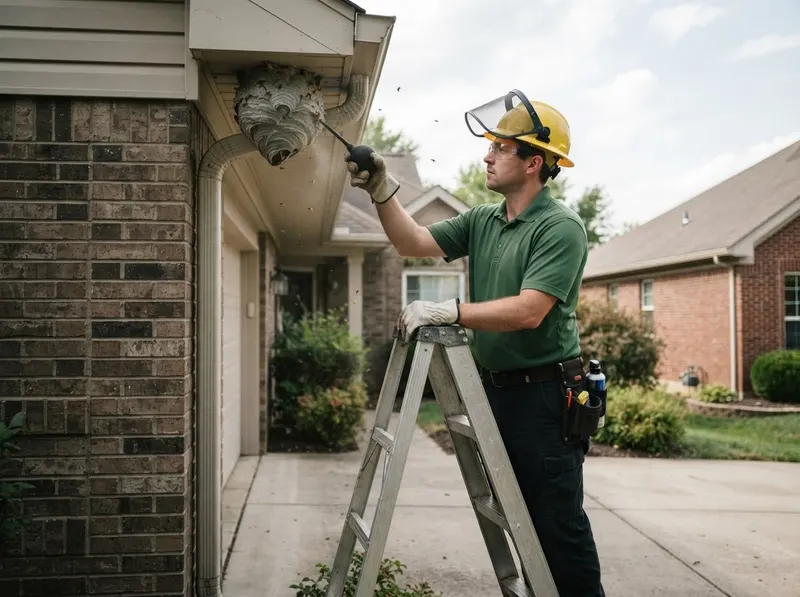
Discovering an active aerial envelope or an active subterranean burrow disrupts household safety, particularly when stinging insects colonize high-traffic areas near patios, entryways, or play structures. Stinging insect and nest abatement addresses species-specific nesting behaviors across Franklin County. According to the Ohio State University Extension, social vespids display aggressive foraging and defensive patterns throughout late summer and early autumn as reproductive castes mature. Proper abatement pairs immediate knock-down formulations with structural nest detachment rather than relying on consumer aerosol sprays that agitate queens and disperse defensive workers throughout exterior wall voids.
In established architectural zones such as the Victorian Village and German Village historic districts, hornets frequently exploit soft mortar lines, roof soffits, and ornate wood trim. Conversely, in Upper Arlington and Bexley, extensive ornamental landscaping and mature shade trees provide canopy cover for baldfaced hornet combs, while sandy soil pockets near the Scioto River in Grandview Heights support subterranean yellowjacket cavities. Regulatory standards outlined by the Ohio Department of Agriculture govern commercial pesticide applications to prevent ground and surface water contamination, aligning treatment parameters with the ecological baselines established by the Ohio Environmental Protection Agency.
Operational procedure proceeds through four defined phases. First, technicians establish thermal or visual confirmation of the brood center to identify flight paths without aggravating the colony. Second, targeted aerosolized botanical compounds or non-repellent dusts registered under the United States Environmental Protection Agency are injected directly into the central entrance to neutralize the brood within 15 to 45 minutes. Third, the outer paper shell or underground comb is physically excavated to eliminate pheromone traces that attract secondary scavengers. Fourth, technicians apply a micro-encapsulated barrier to the surrounding substrate following safety recommendations from the National Institute for Occupational Safety and Health, while evaluating honey bee protection directives supported by the Pollinator Partnership and research from the Entomological Society of America. If honey bees are present, OakVanta Bug Specialists coordinates live extraction pathways alongside registered apiary resources in accordance with the USDA Animal and Plant Health Inspection Service.
Decision guidance hinges on nest access and colony morphology. Homeowners facing exposed eaves can resolve activity via standard localized removal, whereas yellowjacket nests suspended inside drywall or siding require specialized mechanical access and localized void dusting. Applying water or sealing exterior entry holes prior to colony mortality forces insects inward toward living quarters. OakVanta Bug Specialists enforces strict occupational safety practices consistent with the Occupational Safety and Health Administration standard 1910 rules for ladder stabilization and chemical handling, while referencing wildlife shelter parameters from the U.S. Fish and Wildlife Service to avoid disruption to non-target native fauna across Worthington, Clintonville, Franklinton, and the Hilltop.
Every job gets a firm, written price after a free on-site visit.
Tell us about your stinging insect and nest abatement job in Columbus and we'll send a clear, written quote, usually the same day.
 OakVanta Bug Specialists